
TIME:11 - 03 - 2025 By:Yongjian
Centrifugal fans are a type of fan. They operate on the principle of converting kinetic energy into potential energy. A high-speed rotating impeller accelerates the gas, then decelerates and changes its flow direction, thereby converting kinetic energy into potential energy (pressure).
Centrifugal fans are a type of fan. They operate on the principle of converting kinetic energy into potential energy, using a high-speed rotating impeller to accelerate gas flow. The gas is then decelerated and redirected, converting kinetic energy into potential energy (pressure).
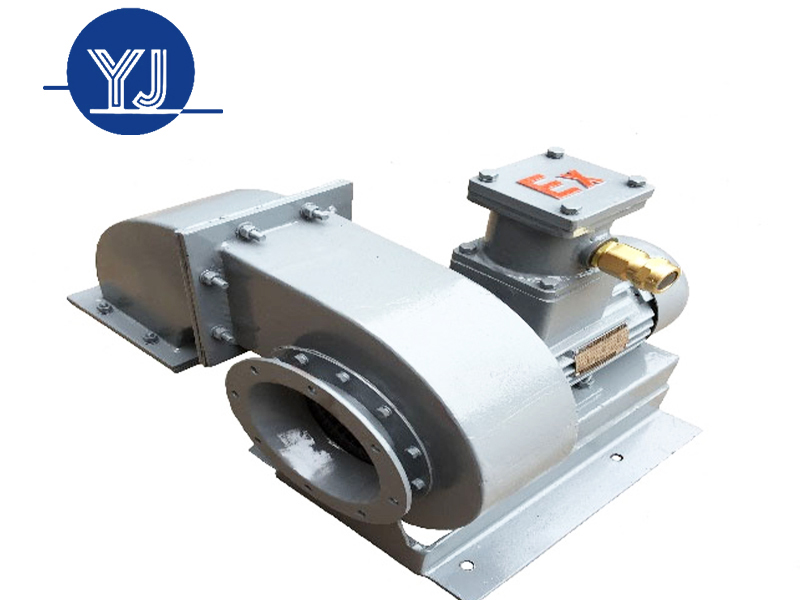
In a centrifugal fan, gas enters the impeller axially. As the gas flows through the impeller, it is driven to change its direction of motion to radial while rotating with the impeller. Simultaneously, under the influence of inertia, the gas gains energy and exits the impeller radially, performing work through the generated centrifugal force.
During operation, the high-speed rotation of the fan impeller generates centrifugal force that expels air from the housing. This expelled air collects in the volute, then is “forced” through the outlet into the ductwork. Simultaneously, the expulsion of air around the impeller creates a “negative pressure zone.” Under atmospheric pressure, external air is drawn into the impeller through the inlet, continuously replenishing the system with fresh air. This cycle constitutes the fan's normal operating state.
Centrifugal fans typically operate at low gas velocities with minimal pressure variation, allowing gases to be treated as incompressible fluids where specific volume changes are negligible. Essentially, centrifugal fans function as variable-flow, constant-pressure devices. At a fixed rotational speed, the theoretical pressure-flow curve should be linear. However, due to internal losses, the actual performance curve exhibits curvature.
The pressure generated by a centrifugal fan is significantly affected by changes in inlet air temperature or density. For a given airflow volume, the lowest pressure is produced at the highest inlet temperature (when air density is lowest). For any given pressure-flow characteristic curve, there corresponds a power-flow characteristic curve. When the fan operates at constant speed, the power required for a given flow rate increases as the inlet air temperature decreases.